Selling the Trip: How Corporate America Learned to Fake Your Crossed Wires
Somewhere in a WeWork conference room in 2019, a brand strategist typed the word "synesthesia" into a PowerPoint deck for the first time and felt genuinely clever about it. We don't know who that person was. But we're pretty sure they started something ugly.
Fast forward to now, and the word is everywhere. Beverage companies are hosting "multisensory tasting experiences." Sneaker brands are dropping NFT collections described as "visual frequencies you can wear." A wellness startup out of Austin literally sells a $180 monthly subscription it calls "chromatic sound therapy" — which, as far as anyone can tell, is a playlist and some colored LED strips shipped to your door in a matte black box.
The commodification of synesthesia — the neurological phenomenon where one sense involuntarily triggers another, like hearing music and seeing color — has arrived. And it's moving fast.
What They're Actually Selling
Let's be clear about something: real synesthesia affects an estimated 4 percent of the population. It's not a vibe. It's a hardwired cross-sensory experience that people are born with, that shapes how they move through the world, and that has quietly informed some of the most genuinely boundary-pushing art and music humans have ever made.
What brands are selling is not that.
What they're selling is the aesthetic of altered perception — the suggestion that their product can unlock something in you that feels transgressive, expanded, outside the ordinary. It's psychedelic culture laundered through a marketing funnel. The counterculture gets strip-mined for its iconography, and what comes out the other end is a $14 "synesthetic cocktail" at a hotel bar in Nashville.
Jordan Feck, a Chicago-based sound artist who performs under the name Pale Hex, has watched this happen in real time. "The language started showing up in press releases maybe three years ago," he told us over the phone. "And at first it was just kind of embarrassing. But now it's got real money behind it, and it's starting to crowd out the actual conversation."
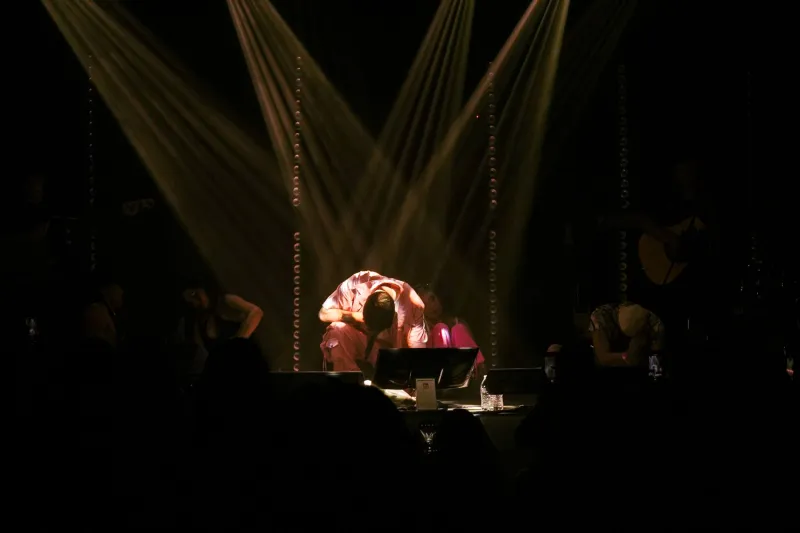
Feck's live sets are genuinely designed around synesthetic principles — he collaborates with a visual artist who has clinically documented synesthesia, and their shows are built from the ground up to create authentic cross-sensory resonance. He's been approached twice by brands wanting to license the concept. Both times he said no.
"They wanted the word," he said. "They didn't want to understand what it means."
The NFT Angle Is Especially Grim
If you want to watch the commodification process in real time, look at what happened in the NFT space circa 2021-2022. A wave of digital art drops leaned hard into synesthesia as a selling point — "music you can see," "color you can hear" — with varying degrees of artistic legitimacy and a remarkably consistent degree of financial opportunism.
Some of it was genuinely interesting. A handful of artists with real synesthetic experience used the format to do something meaningful. But for every one of those, there were fifteen projects using the language as hype scaffolding, promising immersive cross-sensory experiences that amounted to a JPEG and a SoundCloud link.
Marcela Rios, a Miami-based digital artist and self-described "actual synesthete," watched the wave crest and break with a mix of exhaustion and dark amusement. "People kept tagging me in these drops asking what I thought," she said. "And I'd look at them and think — this person has never experienced synesthesia in their life. They just watched a YouTube explainer and decided it sounded cool and profitable."
Rios still works in the NFT space, but deliberately keeps her own practice small and community-focused. "The moment you scale something like this up to mass market, you lose the thing that made it worth doing."
The Entrepreneurs Who Disagree
Not everyone in the emerging sensory-experience industry is shy about what they're doing. We spoke to Derek Calloway, co-founder of a Los Angeles company called Spectral that designs branded multisensory activations for corporate clients — think product launches, influencer events, and hospitality experiences built around the idea of triggering cross-sensory responses.
Calloway is refreshingly upfront. "Are we replicating clinical synesthesia? No. Are we creating conditions where people have genuinely interesting sensory experiences that feel unusual and memorable? Yes. And I don't think there's anything wrong with that."
His argument is essentially that democratizing the feeling of perceptual expansion is a net positive — that if a hotel activation gets someone curious enough to look up what synesthesia actually is, or seek out music that genuinely messes with their senses, that's a door opened, not closed.
It's a reasonable argument. It's also, as Feck pointed out when we relayed it to him, "exactly what someone would say if they'd figured out how to make money off something they didn't create and couldn't fully understand."
Can the Real Thing Survive?
Here's the uncomfortable truth: counterculture has always had this problem. The moment something genuinely strange and powerful emerges from the underground, the market figures out how to sand down its edges and sell it back at a markup. Punk became Hot Topic. Rave culture became Coachella. Psychedelic therapy became a $200 ketamine clinic in Beverly Hills with a branded robe.
The question isn't whether commercialization happens. It's whether the real thing can survive alongside it — whether the actual artists, the actual synesthetes, the actual weirdos doing genuinely experimental work can maintain enough oxygen to keep going.
Rios thinks the answer is yes, but only if the community gets deliberate about it. "You have to be loud about the difference," she said. "You have to make it hard for people to confuse the knockoff with the real thing. That means talking about your process, being specific, not letting the language get diluted without a fight."
Feck is slightly less optimistic but no less committed. "I'm going to keep doing what I do regardless," he said. "The brands will move on to the next thing eventually. They always do. The question is what's left standing when they're gone."
His next show is a warehouse in Pilsen, capacity 200, no corporate sponsors, no branded activations. Just sound, light, and the genuinely strange thing that happens when both are built by people who actually give a damn.
Tickets are fifteen bucks. That feels about right.