Brain Waves for Beats: The Producers Turning Neuroscience Data Into Raw Sound
The session file looks like any other at first glance. Tracks stacked in Ableton, automation lanes, a couple of hardware synth recordings. Then you notice the label on the bottom channel: Subject 7 — REM onset, 40Hz gamma burst, 11.3.2022.
That's not a sample from a record. That's a human brain.
A growing number of experimental producers are working with neuroscience data — EEG recordings, fMRI outputs, galvanic skin response logs, even published academic datasets — as raw material for music. Some are doing it entirely above board, collaborating with researchers and sourcing freely available datasets. Others are operating in considerably grayer territory. All of them are making music that sounds like nothing you've heard before, which is sort of the whole point.
What Brain Data Actually Sounds Like
Before getting into the who and how, it's worth addressing the obvious question: what does an EEG recording sound like when you drop it into a DAW?
Raw brainwave data is, in its native form, a series of voltage fluctuations measured in microvolts across different electrode sites on the scalp. Exported as audio, it's not exactly music — it's closer to a low-frequency rumble with irregular rhythmic bursts, something between a degraded field recording and a broken modular patch. Fascinating to look at on a waveform display. Genuinely weird to listen to.
The work of actually turning that into something musical requires processing, interpretation, and a lot of creative decision-making. And that's exactly where different producers diverge in their approaches.
Some use the raw waveform as a drone source, pitching and filtering it into tonal material. Others convert brainwave frequency bands — delta, theta, alpha, beta, gamma — into rhythmic triggers or oscillator parameters, essentially using the brain's electrical architecture as a sequencer. A few are building Max/MSP patches that translate biometric streams into generative systems in real time.
"It's not about the data being beautiful," says Kael Morrin, a Brooklyn-based producer who has been working with open-source EEG datasets for the past two years. "It's about the data being specific. It came from somewhere real. A real nervous system in a real moment. That specificity changes what you do with it."
The Legal and Ethical Maze
Here's where things get complicated — and interesting.
Neuroscience datasets occupy a genuinely murky legal space when it comes to creative reuse. Many research datasets are published under open-access licenses that technically permit non-commercial use, but those licenses were written with academic replication in mind, not music production. Whether sonifying a published EEG dataset constitutes a copyright issue, a privacy issue, or neither is a question that has no clear legal answer in the US right now.
For anonymized data — where the subject's identity has been stripped — most legal experts would say you're probably fine. But "probably fine" is doing a lot of work in that sentence.
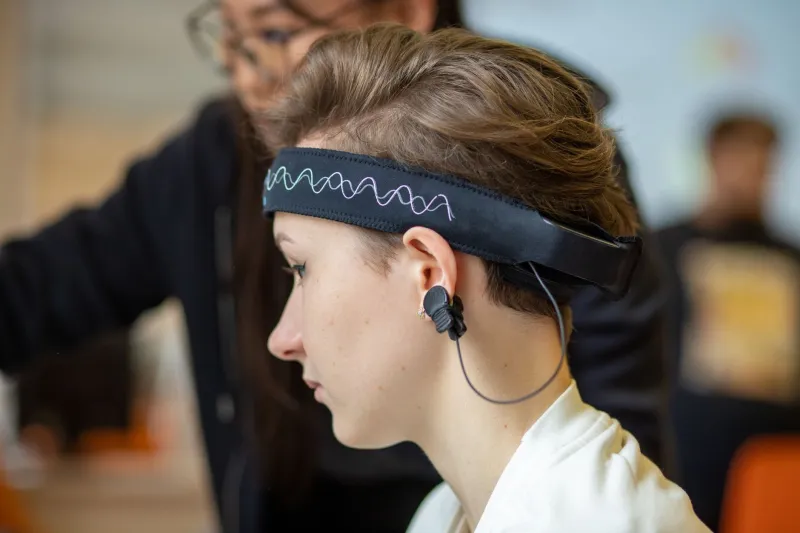
The privacy dimension gets heavier when producers start sourcing data from less formal channels. Consumer-grade EEG headsets like the Muse or OpenBCI rigs have made it possible for people to record their own brain activity easily, and a small community has emerged around sharing these personal recordings for creative use. Some of that sharing is enthusiastically consensual. Some of it... less so.
"I have definitely received files where I had questions about where they came from," admits one producer who asked not to be named. "I didn't use them. But they were out there, being passed around."
On the other side of the spectrum, a handful of neuroscientists have become genuine collaborators in this space — researchers who find the creative reinterpretation of their work genuinely compelling.
Dr. Priya Nandakumar, a cognitive neuroscientist at UC San Diego whose lab studies auditory processing, has been informally advising producers for about eighteen months. "My first reaction was skepticism," she says. "But then I actually listened to what they were making, and there was something in it that felt true to the data in ways I didn't expect. They were finding patterns I hadn't thought to listen for."
She now shares processed versions of her lab's published datasets directly with artists who reach out, with a simple ask: credit the source.
New Subgenres From the Nervous System
The music emerging from this practice doesn't fit neatly into existing genre categories — which is, honestly, a feature rather than a bug for the people making it.
Morrin's work sits somewhere between dark ambient and industrial, with a biological pulse underneath everything that keeps it from feeling cold or mechanical. Others are pushing toward something more rhythmic: producers like LA-based collective Nerve Map have been building sets entirely from biometric triggers, where kick patterns are derived from cardiac data and hi-hat rhythms follow galvanic skin response curves from anxiety studies. The result is dance music that feels physiologically correct in ways that standard programmed beats don't — because the rhythms were, in a literal sense, generated by bodies.
There's also a growing practice of live biometric performance, where producers wear EEG rigs or heart rate monitors onstage and route their own real-time nervous system data into their live sets. Your brainwaves become the modulation source. Your stress response shapes the filter sweep. The performance and the performer become genuinely inseparable.
"The first time I played a set like that, I had a panic attack about twenty minutes in," says Dara Ose, who performs under the name Cortical Drift and has been developing a live biometric rig for the past year. "And the music went completely sideways in the best possible way. The audience didn't know what was happening, but they felt it. Something communicated."
The Instrument You Can't Separate From
What makes this practice philosophically interesting — beyond the novelty — is what it implies about the relationship between creator, instrument, and sound.
Every instrument creates a distance between the musician's intention and the resulting sound. You think a note; you play a note; the instrument transforms that intention into vibration. Biometric music collapses that distance almost entirely. The instrument is the musician, at a neurological level.
That has implications for what music means, for what authorship means, and for what listening means when you know the sound you're hearing originated in someone else's brain.
Nandakumar puts it simply: "There's a direct line between a human nervous system and your ears. That's not metaphor. That's literally what's happening. I think that's worth sitting with."
So do we.