Dust, Voltage, and Vibes: How Gen Z Fell Hard for Analog Synths
There's a certain kind of Saturday morning that only happens in the outer boroughs of New York, in the sprawling flea markets of Portland, or in the climate-controlled back rooms of vintage shops in Austin — the kind where someone's grandmother's estate gets picked over by a twenty-three-year-old in a Cluster t-shirt, hunting for a Korg MS-20 buried under a pile of ceramic owls. This is the new gold rush, and the treasure isn't crypto or vintage Jordans. It's oscillators.
The analog synth revival isn't exactly news. Boutique manufacturers have been cashing in on nostalgia for years, and every major gear company has dropped some kind of "classic reissue" to capitalize on the retro-hardware craze. But what's genuinely surprising — and genuinely exciting — is who is driving the current wave of obsession. It's not the aging prog-rock collectors. It's Gen Z producers, many of whom grew up with Ableton as their first instrument, who are now evangelizing the gospel of voltage with near-religious intensity.
Why Digital Got Boring First
To understand the analog hunger, you have to understand what it's replacing. Modern music production software is, by almost any objective measure, astonishing. You can summon the sound of a 1973 Minimoog from a plugin in about four seconds, tweak it with surgical precision, and have it perfectly in tune forever. It never drifts. It never surprises you. It does exactly what you tell it to do.
And that, it turns out, is the problem.
"When I was only working in the box, I felt like I was filling out forms," says Delia V., a 24-year-old ambient producer based in Chicago who releases music under the name Glassmouth. "Everything was so clean and correctable that I stopped making decisions. I'd just... undo everything. The analog stuff forces you to commit. When the filter does something unexpected, that is the song now."
That philosophy — embracing the machine's personality rather than overriding it — is a throughline in almost every conversation you have with young hardware devotees. The unpredictability isn't a bug. It's the whole point. It's the sonic equivalent of tearing up the map and driving into the desert.
The Estate Sale Circuit and the Thrill of the Hunt
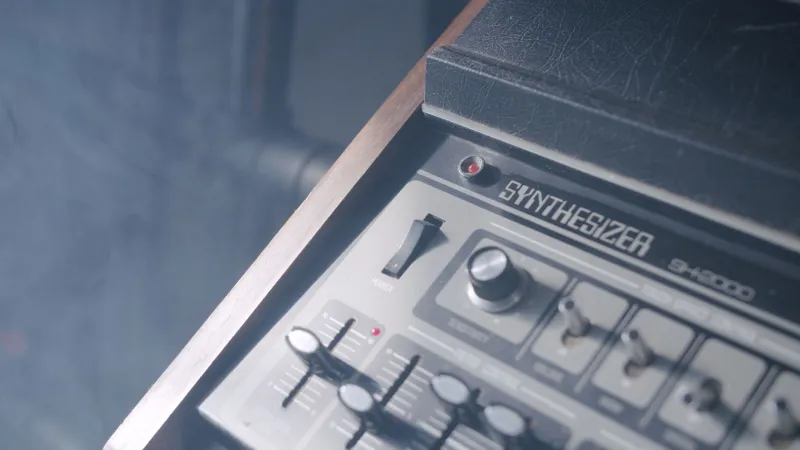
Part of what makes this movement feel genuinely countercultural, rather than just another gear trend, is the way these instruments are being sourced. Sure, you can buy a reissued Roland SH-101 from a retailer. But there's a subculture of younger producers who specifically seek out original hardware — not for investment purposes, but because they want the machine with forty years of cigarette smoke and accidental voltage spikes baked into its character.
Facebook Marketplace, Craigslist, local estate sale apps, and word-of-mouth networks within producer Discord servers have become the new hunting grounds. The thrill of finding a Buchla module in a storage unit in Tucson, or pulling a working Arp Odyssey from a church rummage sale in Ohio, carries a kind of mythology that no Amazon purchase can replicate.
"I found my Roland Juno-60 at an estate sale in New Jersey," says Marcus T., who produces experimental electronic music as Tar Meridian. "The guy who owned it was apparently in a synth-pop band in the 80s that never made it. There's something about that history that lives in the instrument. I know that sounds woo-woo, but the sounds I make on that machine feel different from anything I've programmed."
It does sound a little woo-woo. It also sounds completely correct.
Patching as Practice: The Meditative Dimension
One angle that doesn't get enough attention in the mainstream gear press is the almost meditative quality of working with modular and semi-modular systems. Patching a Eurorack system — running cables between modules, discovering how signals interact, following a sound through unexpected transformations — is a fundamentally different cognitive experience than clicking through menus.
Several producers we spoke to described the process using language that wouldn't be out of place in a conversation about psychedelics or mindfulness. You're not building toward a predetermined outcome. You're exploring a space, following curiosity, letting the system show you what it wants to become.
That maps pretty cleanly onto the countercultural ethos that's always animated the best experimental music — the idea that dissolution of control leads somewhere more interesting than total command ever could. The Moog doesn't care about your deadline. The oscillator drifts when it wants to drift. Learning to work with that rather than against it is, for a lot of these producers, a genuine philosophical shift.
The Community Holding It All Together
What really distinguishes this moment from previous analog revivals is the infrastructure of community that's grown up around it. Online forums like Modwiggler, subreddits dedicated to specific synth families, and tight-knit Discord servers have created spaces where a teenager in rural Nebraska can get real-time patching advice from someone in Berlin, or find out where to source a replacement capacitor for a broken Oberheim.
That democratization of knowledge is significant. Analog synthesis used to require either serious money or serious connections — ideally both. The combination of accessible secondhand markets, online community expertise, and a new generation of affordable semi-modular gear (Behringer's controversial but undeniably cheap clones, Moog's Mother-32, Make Noise's Strega) has lowered the floor considerably.
The culture that's formed around all this hardware isn't just about the music, either. It's about a particular relationship with technology — one that's tactile, imperfect, and resistant to the kind of algorithmic smoothing that defines so much of contemporary digital life. In a moment when everything is being optimized, there's something genuinely radical about choosing the machine that fights back.
The Sound That Comes Out the Other Side
So what does all this obsession actually produce? Listen to the output of producers like Glassmouth, Tar Meridian, or the growing constellation of artists releasing on Bandcamp labels like Opal Tapes and Hausu Mountain, and you'll hear something that couldn't have come from a preset browser. There's texture, there's movement, there's the sense of a system breathing.
It's psychedelic in the original sense — mind-revealing. The machine reveals itself, the player reveals themselves, and somewhere in that feedback loop, something genuinely new happens.
The kids are alright. They're also covered in patch cables and mildly obsessed with voltage-controlled filters, which, honestly, is exactly where we want them.